ASUS ZenBook Flip 13 UX363 review
ASUS ZenBook Flip 13 UX363 — from 2021, 1.3 kg, performance 38.
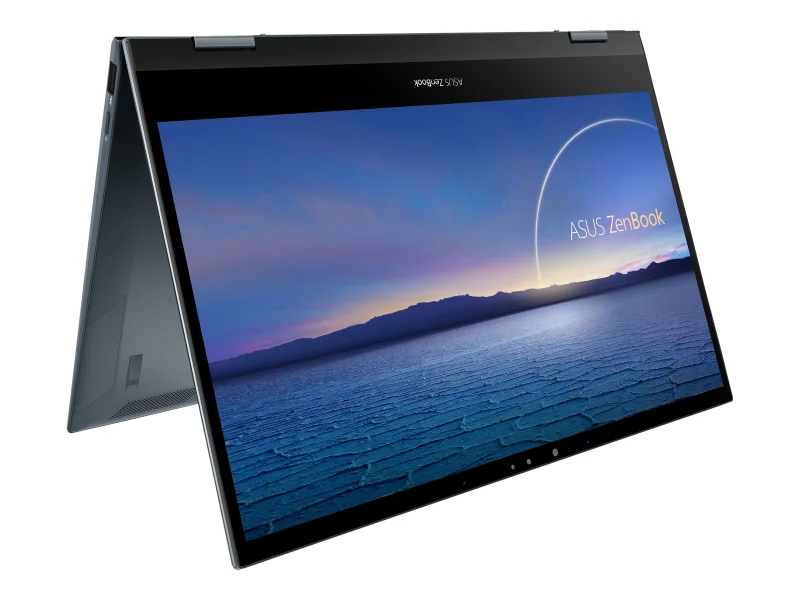
Technical specifications
| Type | Ultrabook |
| Release year | 2021 |
| Screen | 13.3" · 1920x1080 |
| Processor | Intel Core i5 1135G7 , Intel Core i7 1165G7 , Intel Core i5 1035G1 |
| Max. RAM | 16 GB |
| Weight | 1.3 kg |
| Battery | 67 Wh |
Performance scores
A five-year-old convertible that still carries top-quartile
The ZenBook Flip 13 (UX363) of 2021 asks $739 with a Core i5-1135G7, 16 GB of RAM, and a folding hinge. Its verified strengths are mobility at 78 — 21.9 percent above the ultrabook median of 64, top quartile — and graphics placing at 14.08 against a 3.84 class median, a 266.7 percent advantage of the office-tier kind: real, measured, and modest. The flagged weakness is the 16 GB memory ceiling, half the class median, in the budget segment.
The fold-and-carry case
A convertible lives or dies by how it carries, and mobility 78 in the top quartile says this one lives: the 1135G7 is an efficiency-tier part, the body is the classic sub-1.3 kg ZenBook school, and the hinge adds tablet and tent modes without adding penalty weight. For note-taking, reading, and media in folded forms, the chassis is the product, and five years have not changed that.
The minimum-bar envelope
The capability sheet clears Overwatch, GTA V, and Rainbow Six Siege at minimum, plus Visual Studio Code at minimum — the honest scope of Tiger Lake integrated graphics in 2026. Older and lighter titles pass at the floor bar; no recommended-tier claim exists, and none should be inferred from the 266.7 percent placing, which measures against an unscored-heavy class median. The 16 GB ceiling is the other honest boundary, flagged at half the class norm.
Flat decay
The measured rate is 9.44 percent per year with no unit anchor — the gentle end of this batch. Two years retain roughly five-sixths of the $739. Convertible chassis with top-quartile mobility hold their utility band; the depreciation risk on this ticket is small.
Positioning on the shelf
No analog peers are returned. Within the batch, the newer Vivobook 14 Flip of 2025 at $1,275 carries the modern 226V platform and a reliability 86 — the new-body seat of the same idea — while this UX363 remains the budget entry to the folding format.
Bottom line
For a buyer who wants the fold-and-carry format at a mid-tier ticket and whose workload fits minimum-bar graphics and 16 GB, this machine's numbers hold up honestly: top-quartile mobility, measured office-tier graphics, flat decay. It is a tool purchase, not a performance purchase, and the data keeps the distinction clean.
🧭 Your context
Stage: Refining requirements
You're refining — compare finalists head-to-head.
🎯 For your profile
You've viewed: You've recently viewed 25 models — compare this model with them in the analogs matrix.
⭐ What stands out
-
graphics performance is higher than typical ultrabook class (+200%) (office tier).
above class average -
memory capacity is lower than typical ultrabook class (+50%) (comfort).
budget segment of category -
mobility is higher than typical ultrabook class (+21.9%) (high tier).
top 25% of its category
🎮 What it can run
⚙️ Configuration analysis
Top configuration handles modern AAA games at high settings, video editing, and heavy multitasking.
🤔 How to choose
Universal advice for any use case.
- Reliability vs price: reliability (median 51) ↔ price (median 373.2).
- Weight vs CPU: mobility (median 64) ↔ overall performance (median 41.7).
- Upgradeability vs battery: upgradability (median 50) ↔ battery life (median 4.4).
ZenBook Flip 13 UX363: verdict
➡️ Next step
You're refining — compare finalists head-to-head.