ASUS ZenBook S UX393 review
ASUS ZenBook S UX393 — from 2020, 1.35 kg, performance 34.
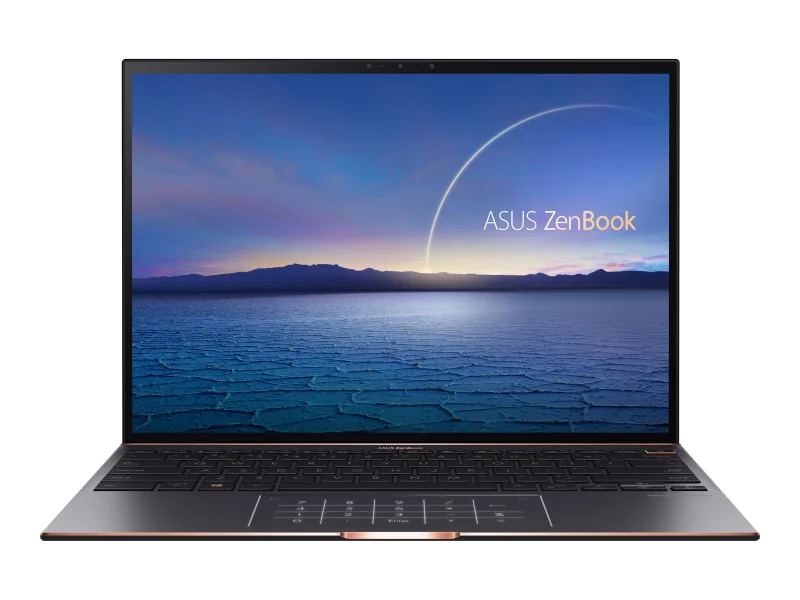
Technical specifications
| Type | Ultrabook |
| Release year | 2020 |
| Screen | 13.9" · 3300x2200 |
| Processor | Intel Core i5 1135G7 , Intel Core i7 1165G7 |
| Max. RAM | 16 GB |
| Weight | 1.35 kg |
| Battery | 67 Wh |
Performance scores
A six-year-old premium chassis selling its CPU, not its era
The ZenBook S UX393 of 2020 asks $650 today, and the data describes a machine split across two eras: its Core i5-1135G7 compute still places at 70 against an ultrabook median of 59.81 — 17 percent above, top quartile — while its overall performance index of 33.66 sits 19.3 percent below the class median and the aggregate score of 40 trails by a similar margin. The flagged weakness is memory: a 16 GB ceiling at half the class median, in the budget segment for the class. Six years in, the premium chassis is the body and the 1135G7 is the still-beating heart.
The CPU carries the ticket
Top-quartile compute on a six-year-old ultrabook is the machine's one verified strength, and it is a real one: the 1135G7 was an efficiency-tier Tiger Lake part whose single-thread pace still handles office loads, browsing, and media without struggle. Buyers get a processor that outplaces most of its classmates' medians even now. The caveat is equally plain — the performance index that blends everything lands below median, so the CPU advantage does not rescue the whole machine.
The honest ceilings
Memory stops at 16 GB — flagged at half the class median — and the capability sheet is empty, meaning no gaming or software claims survive the data. The overall performance index reads in the low band. The summary the numbers support: this is a writing, browsing, and office machine with a good engine and dated surroundings, not a creative or gaming purchase. The era of the platform, not any single failure, is the constraint.
The gentlest slope in the batch
The measured rate is 8.93 percent per year with no launch anchor — the flattest decay curve among this batch's machines. Six-year-old premium bodies that have already absorbed most of their depreciation tend to plateau. Two more years at this rate retain roughly five-sixths of the ticket, making the residual risk as small as these numbers get.
Positioning on the shelf
No analog peers are returned. The batch's premium-shelf neighbors — the Zenbook S 13 OLED models a year or two younger at $840 to $954 — carry newer efficiency silicon and stronger mobility readings for a couple hundred more. The UX393's case is the price of admission to the premium chassis tier.
Bottom line
For a buyer who wants the premium-ultrabook experience at a mid-tier ticket and whose workload fits 16 GB and an empty capability sheet, the UX393's top-quartile CPU and gentle decay make a quiet case. Anyone needing memory headroom or verified gaming receipts has already scrolled past. The machine is honest about what six years bought and what they cost.
🧭 Your context
Stage: Refining requirements
You're refining — compare finalists head-to-head.
🎯 For your profile
You've viewed: You've recently viewed 35 models — compare this model with them in the analogs matrix.
⭐ What stands out
-
memory capacity is lower than typical ultrabook class (+50%) (comfort).
budget segment of category -
overall performance is lower than typical ultrabook class (+19.3%) (low tier).
below class average -
composite score is lower than typical ultrabook class (+18.4%).
below class average
⚙️ Configuration analysis
Top configuration handles modern AAA games at high settings, video editing, and heavy multitasking.
🤔 How to choose
Universal advice for any use case.
- Reliability vs price: reliability (median 51) ↔ price (median 373.2).
- Weight vs CPU: mobility (median 64) ↔ overall performance (median 41.7).
- Upgradeability vs battery: upgradability (median 50) ↔ battery life (median 4.4).
ZenBook S UX393: verdict
➡️ Next step
You're refining — compare finalists head-to-head.