ASUS Vivobook Pro 16 (K6602) review
ASUS Vivobook Pro 16 (K6602) — from 2022, 1.9 kg, performance 66.
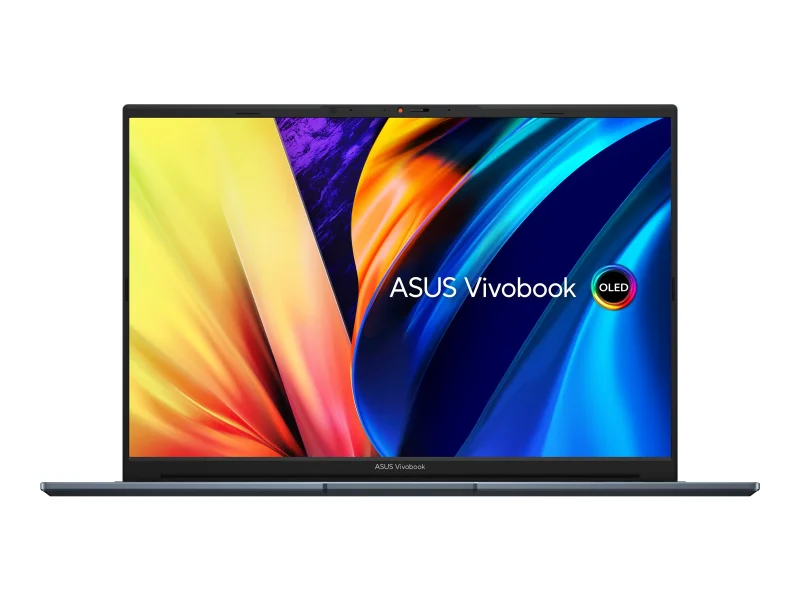
Technical specifications
| Type | Laptop |
| Release year | 2022 |
| Screen | 16" · 1920x1200 |
| Processor | Intel Core i7 12650H , Intel Core i7 12700H , Intel Core i5 13500H , Intel Core i7 13700H , Intel Core i9 13900H |
| Graphics | GeForce RTX 3050 Mobile 4GB , GeForce RTX 3050 Ti Mobile 4GB , GeForce RTX 4050 Mobile 6GB , GeForce RTX 4060 Mobile 8GB |
| Max. RAM | 32 GB |
| Weight | 1.9 kg |
| Battery | 70 Wh |
Performance scores
A real RTX 3050 with a rec-tier sheet at $470
The Vivobook Pro 16 (K6602) of 2022 is the value anomaly of this batch's general shelf: a Core i7-12650H, an RTX 3050, and 32 GB of RAM asking $470. Its graphics place at 75.91 against a general-class median of 27.24 — 178.7 percent above, top quartile; its performance index at 66.07 runs 53.5 percent above median, top quartile; and its 70 Wh battery reads 45.8 percent above the class norm in the large tier. The flagged weakness is mobility at 40, a mild 20 percent below median in the mid band.
The receipts at a floor price
Overwatch, GTA V, and Rainbow Six Siege clear recommended; Photoshop and Visual Studio Code clear minimum. A discrete 3050 with a fully green rec-tier sheet at $470 — on the general shelf, in a year when gaming-shelf 3050 machines ask $737 — is the batch's clearest per-dollar graphics case. The 12650H is genuine H-series hybrid compute, and the 66.07 performance index says the platform around the GPU is no afterthought.
The one flag, in its proportion
Mobility at 40 is the single flagged weakness: a fifth below the class median, mid band, the ordinary cost of a 16-inch body carrying H-series silicon and a 70 Wh battery. The portability reading will sit lower — this is a working machine that commutes, not one that disappears into a sleeve. Against what the $470 buys in the other columns, the flag is a footnote, and the data prints it as one.
Mid-tier decay
The measured rate is 11.94 percent per year with no unit anchor. Two years retain roughly three-quarters of the $470. A floor-ticket machine with top-quartile receipts is the profile where depreciation matters least in absolute terms.
Positioning on the shelf
No analog peers are returned. The nearest kin is this batch's own Vivobook Pro 16X OLED at $737 — the same 3050 platform on the gaming shelf for $267 more, buying a 90 Wh battery and an OLED panel. The K6602's $470 makes that premium look like what it is: a screen-and-shelf surcharge on identical graphics.
Bottom line
For a buyer who wants verified recommended-tier gaming and H-series compute at the lowest discrete-GPU ticket in this batch, this is the seat, and no column on the sheet argues against it except a mid-band mobility reading stated in full. The 16X sibling costs $267 more for the same frames. This is the rational version of that machine.
🧭 Your context
Stage: Refining requirements
You're refining — compare finalists head-to-head.
🎯 For your profile
You've viewed: You've recently viewed 20 models — compare this model with them in the analogs matrix.
⭐ What stands out
-
graphics performance is higher than typical general laptop class (+178.7%) (high tier).
top 25% of its category -
overall performance is higher than typical general laptop class (+53.5%) (high tier).
top 25% of its category -
battery capacity is higher than typical general laptop class (+45.8%) (large tier).
top 25% of its category
🎮 What it can run
⚙️ Configuration analysis
Top configuration handles modern AAA games at high settings, video editing, and heavy multitasking.
🤔 How to choose
Universal advice for any use case.
- Reliability vs price: reliability (median 54) ↔ price (median 247.9).
- Weight vs CPU: mobility (median 50) ↔ overall performance (median 43.1).
- Upgradeability vs battery: upgradability (median 50) ↔ battery life (median 2.3).
Vivobook Pro 16 (K6602): verdict
➡️ Next step
You're refining — compare finalists head-to-head.