ASUS Vivobook 14 (X1404) review
ASUS Vivobook 14 (X1404) — from 2023, 1.4 kg, performance 40.
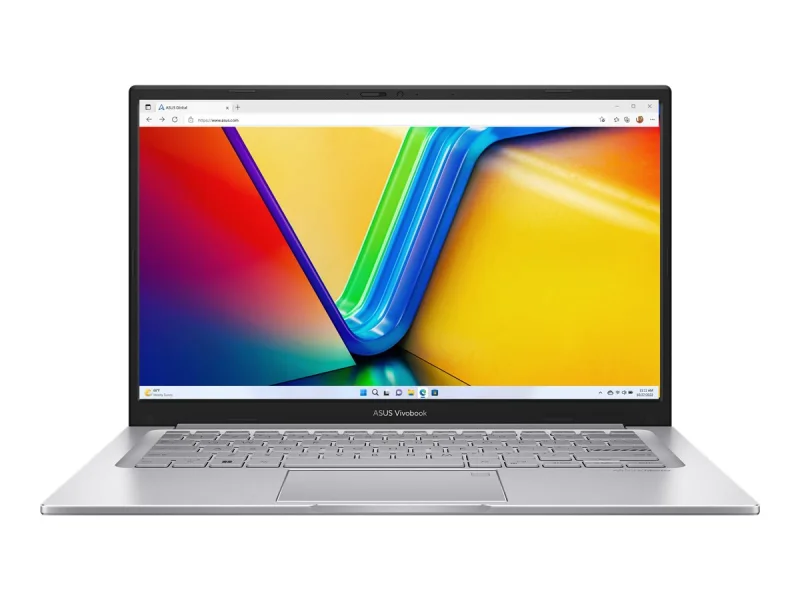
Technical specifications
| Type | Laptop |
| Release year | 2023 |
| Screen | 14" · 1920x1080 |
| Processor | Intel Core 3 100U , Intel Core 5 120U , Intel Core 7 150U , Intel Core i3 1215U , Intel Core i5 1235U , Intel Core i7 1255U , Intel Core i3 1315U , Intel Core i5 1335U , Intel Core i7 1355U , AMD Ryzen 3 7320U , AMD Ryzen 5 7520U |
| Max. RAM | 16 GB |
| Weight | 1.4 kg |
| Battery | 42 Wh |
Performance scores
The five-fifty-three carry machine
The ASUS Vivobook 14 (X1404) is a 2023 general-class machine: an Intel Core 3 100U with 16GB of memory at $553. The sheet reads mobility at 81 — sixty-two percent above the class median, top-quartile — as the strength; the recorded weak axis is the 16GB memory ceiling at half the class norm, with the integrated graphics placing of 14.08 at forty-eight percent below median alongside.
Mobility as the product
In a class whose machines average mediocre carry readings, an 81 mobility index at a $553 ticket is the entire value proposition: this is a machine bought to be carried — student bag, commuting, couch-to-desk — with the Core 3 100U providing honest office-pace compute for the load. The flag sheet calibrates the rest: Overwatch, Grand Theft Auto V and Rainbow Six Siege clear minimums, Visual Studio Code clears minimum. Light titles at low bars, real productivity work, nothing more — and nothing claimed beyond it.
The honest constraints
Two readings bound the ticket: the 16GB ceiling that heavy multitaskers outgrow, and the graphics placing below class median that keeps every visual ambition at the minimum level. Neither is a defect at the price — they are the specs the money buys — and the value verdict prices the machine fairly against its class. The buyer wanting the same carry reading with a measured graphics surplus climbs to the Zenbook shelf; the buyer wanting capability stays at this ticket and accepts the calibration.
No depreciation anchor
No release-price anchor is recorded; the platform convention runs near thirteen percent per year. On a mid-tier ticket with a modest curve, the mobility figure — not the depreciation — is the number that justifies the purchase.
Positioning against the aisle
No recorded analogs fall within the comparison band. Within the batch the Zenbook 15 OLED at $954 offers the stronger measured platform for $401 more; at this ticket the Vivobook 14 holds the carry-first corner alone.
Bottom line
A fairly-priced mobility-first machine with minimum-level verified flags and two honestly-recorded constraints. Buy it when the bag weight matters more than any other spec; the data says exactly what the money buys.
🧭 Your context
Stage: Refining requirements
You're refining — compare finalists head-to-head.
🎯 For your profile
You've viewed: You've recently viewed 30 models — compare this model with them in the analogs matrix.
⭐ What stands out
-
mobility is higher than typical general laptop class (+62%) (high tier).
top 25% of its category -
memory capacity is lower than typical general laptop class (+50%) (comfort).
below class average -
graphics performance is lower than typical general laptop class (+48.3%) (office tier).
below class average
🎮 What it can run
⚙️ Configuration analysis
Top configuration handles modern AAA games at high settings, video editing, and heavy multitasking.
🤔 How to choose
Universal advice for any use case.
- Reliability vs price: reliability (median 54) ↔ price (median 247.9).
- Weight vs CPU: mobility (median 50) ↔ overall performance (median 43.1).
- Upgradeability vs battery: upgradability (median 50) ↔ battery life (median 2.3).
Vivobook 14 (X1404): verdict
➡️ Next step
You're refining — compare finalists head-to-head.