ASUS Zenbook 15 OLED (UM3504) review
ASUS Zenbook 15 OLED (UM3504) — from 2023, 1.4 kg, performance 54.
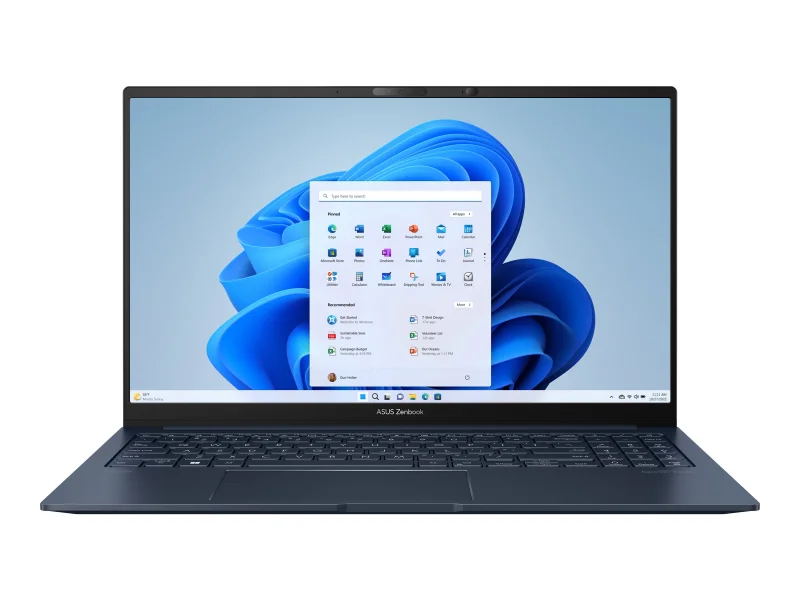
Technical specifications
| Type | Ultrabook |
| Release year | 2023 |
| Screen | 15.6" · 1920x1080 |
| Processor | AMD Ryzen 5 7535U , AMD Ryzen 7 7735U |
| Max. RAM | 32 GB |
| Weight | 1.4 kg |
| Battery | 67 Wh |
Performance scores
The OLED ultrabook with surplus graphics
The ASUS Zenbook 15 OLED (UM3504) is a 2023 premium ultrabook: an AMD Ryzen 5 7535U with 32GB of memory at $954. The peer comparison records no weak axis. The sheet reads the integrated graphics placing at 32.85 — more than eight times the ultrabook-class median of 3.84 — with performance at 54.44 and reliability at 65, both top-quartile.
Integrated graphics, measured properly
The 7535U's Radeon silicon places at 32.85 — eight and a half times the class median — in a shelf where the typical machine has no graphics story at all, and the flags verify the placing: Overwatch clears recommended, Grand Theft Auto V clears recommended at a measured 140 frames per second, Far Cry 5 clears minimum at 30 measured, and Photoshop with Visual Studio Code clear minimums. This is the honest tier of strong integrated graphics — light-to-mid gaming and real photo work on a machine built for neither headline — and the absolute gaming level adds its calibration: 34, the upper edge of the low band, a placing that describes capability without ever promising a gaming machine.
The premium-shelf question
At $954 the ticket prices a premium consumer ultrabook, and the sheet supports the premium on three axes at once: the display-class chassis implied by the OLED line, the top-quartile performance placing, and the top-quartile reliability reading — a combination the ultrabook shelf rarely offers together. The 32GB ceiling is the class-standard complement. The buyer's alternative at this money is the gaming shelf's heavier machines; the differentiation here is the frame and the panel.
No depreciation anchor
No release-price anchor is recorded; the platform convention runs near eleven percent per year. The gentle tier band reflects the class's slow decay — the buyer's exposure is conventional.
Positioning against the aisle
No recorded analogs fall within the comparison band. Within the batch, the Zenbook Pro 17 at $840 offers a real RTX 3050 in an ultrabook shell with a mobility penalty; this seat's case is the balanced OLED package without the weight trade.
Bottom line
A fairly-priced, no-weakness premium ultrabook whose integrated graphics are measured, flag-verified and far above class norm. Buy it for the panel and the frame with light creative duty on the side; the gaming shelf serves the frame-rate buyer better.
🧭 Your context
Stage: Refining requirements
You're refining — compare finalists head-to-head.
🎯 For your profile
You've viewed: You've recently viewed 30 models — compare this model with them in the analogs matrix.
⭐ What stands out
-
graphics performance is higher than typical ultrabook class (+200%) (light tier).
above class average -
overall performance is higher than typical ultrabook class (+30.5%) (mid).
top 25% of its category -
reliability is higher than typical ultrabook class (+27.5%) (mid).
top 25% of its category
🎮 What it can run
⚙️ Configuration analysis
Top configuration is sufficient for office work, media playback, and older or undemanding games.
🤔 How to choose
Universal advice for any use case.
- Reliability vs price: reliability (median 51) ↔ price (median 373.2).
- Weight vs CPU: mobility (median 64) ↔ overall performance (median 41.7).
- Upgradeability vs battery: upgradability (median 50) ↔ battery life (median 4.4).
Zenbook 15 OLED (UM3504): verdict
➡️ Next step
You're refining — compare finalists head-to-head.